
Cuts could mean less teacher, student interaction
Reprinted with permission from the Claremore Progress. This article originally appeared on Jun 21, 2016. Support local journalism with a subscription or a day pass for $1.99 :)
Claremore High School business and technology teacher Cass Huddleston helps her students gain Photoshop skills through classroom instruction and one-on-one training. Huddleston is concerned that personalized instruction will be unavailable in growing classrooms.
“I wouldn’t be able to sit and talk with students and provide them any personal grading,” she said. “Claremore has this pool of really sharp students. The teachers work really hard to get them there, but there has to be a breaking point where quality goes down a little, not because teachers are not trying just as hard, but because there are so many students.”
Currently, Huddleston is not experiencing growth in her classroom size because she cannot have more students than computers in a technology class. She also purchased new software and curriculum last year, and hopes the budget in Oklahoma is better when her students need updated technology.
“I have been told it was a good thing we bought the books, otherwise we would have not had books to go with the software. It is really tough to teach software we do not have books for,” she said. “I see this unfolding, I am just fortunate I ordered everything last year.”
Huddleston said some of her students leave the classroom with skills that make them job-ready. She said several of her students find design or photography jobs without college or while in college. Her students have the opportunity to be successful because they have access to current technology that makes them competitive in the job market and prepared for the college track.
“My concern is students will not be graduating with the latest training and skills. It is really important to have cutting edge software. Luckily, to this point, we have kept up,” she said.
Next year, the business and technology department will not offer any new courses, which means students are paying for the budget cuts through decreased course availability.
“So if I said, lets teach Adobe Illustrator and Flash, but now we can’t offer any new classes even if we have the software. Every year we want to mix it up and give them more opportunities,” said Huddleston.
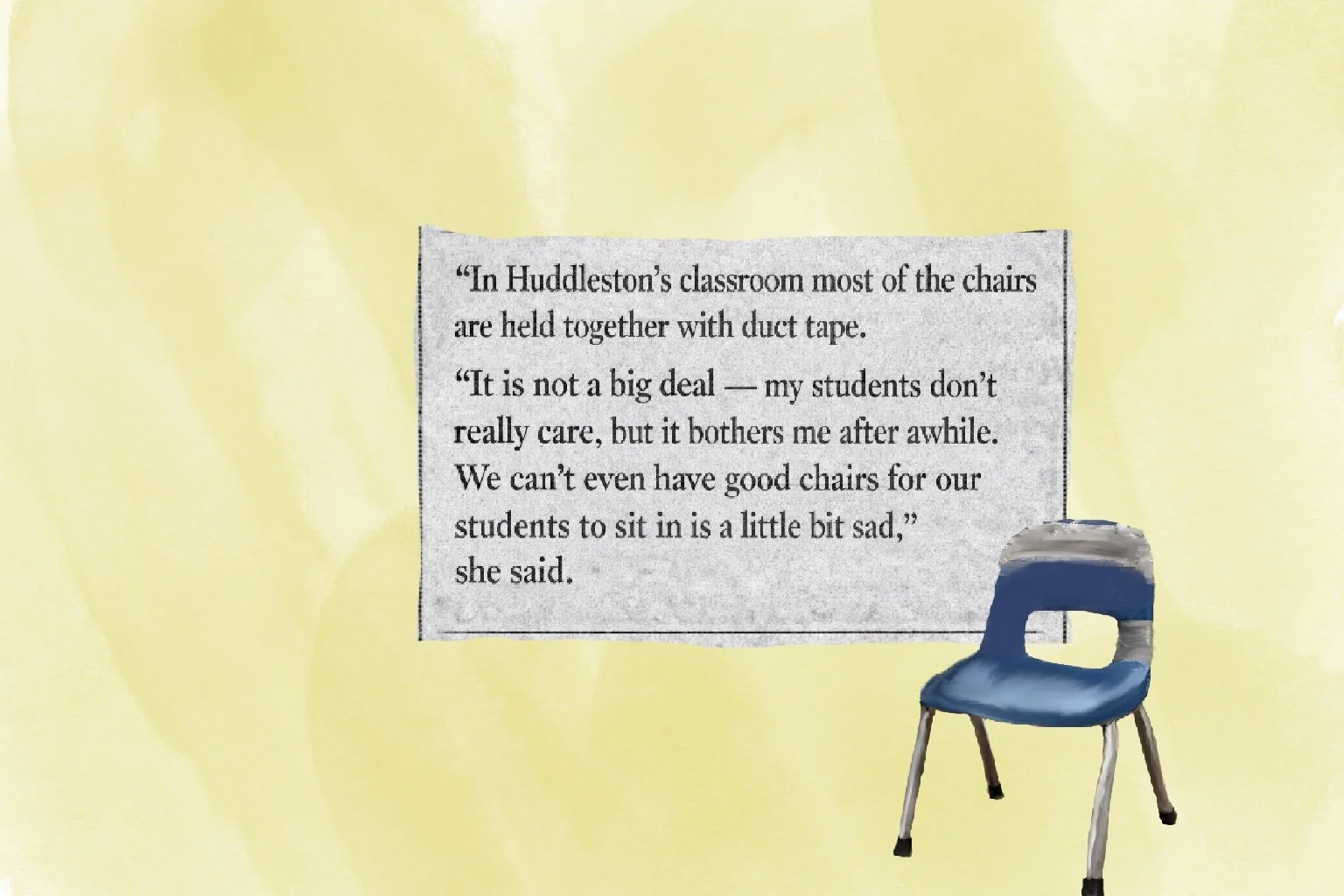
She said students are also paying for budget cuts by learning with outdated textbooks and paying new lab fees for extracurricular courses. In Huddleston’s classroom most of the chairs are held together with duct tape.
“It is not a big deal — my students don’t really care, but it bothers me after awhile. We can’t even have good chairs for our students to sit in is a little bit sad,” she said.
She said her biggest concern is not teacher pay but student sacrifice.
“My concern is not a pay raise, not that I am thrilled about what I make, but what is really bad is what we have for our students,” she said. “There is no budget for our department. If we did not take a lab fee there would be zero dollars for our department, and that is hard. They don’t have money if they need color paper or card stock.”
Huddleston said the consequences of the budget cuts could mean students are less prepared for college or the workforce, which she said would impact the entire state.
“These students are our future. Oklahoma, currently not looking good, sadly we are at the bottom of a lot of rankings. If we want our state to grow, how will it happen if we don’t have the professionals to bring them,” she said. “I love our state, but one of the most frustrating things, being a teacher in Oklahoma, is somehow we are not heard by our state government. It is almost as if our voice is not heard — but who else is going to speak for us?”
Editor’s note: This is the third in a series of stories on the challenges local teachers face in the classroom during the current budget crisis.