
Teaching during budget crisis requires resilience
Reprinted with permission from the Claremore Progress. This article originally appeared on Jun 21, 2016. Support local journalism with a subscription or a day pass for $1.99 :)
Claremont Elementary School started the year with only $2,000 in its general fund budget, which means teachers and administrators struggle to supply classrooms.
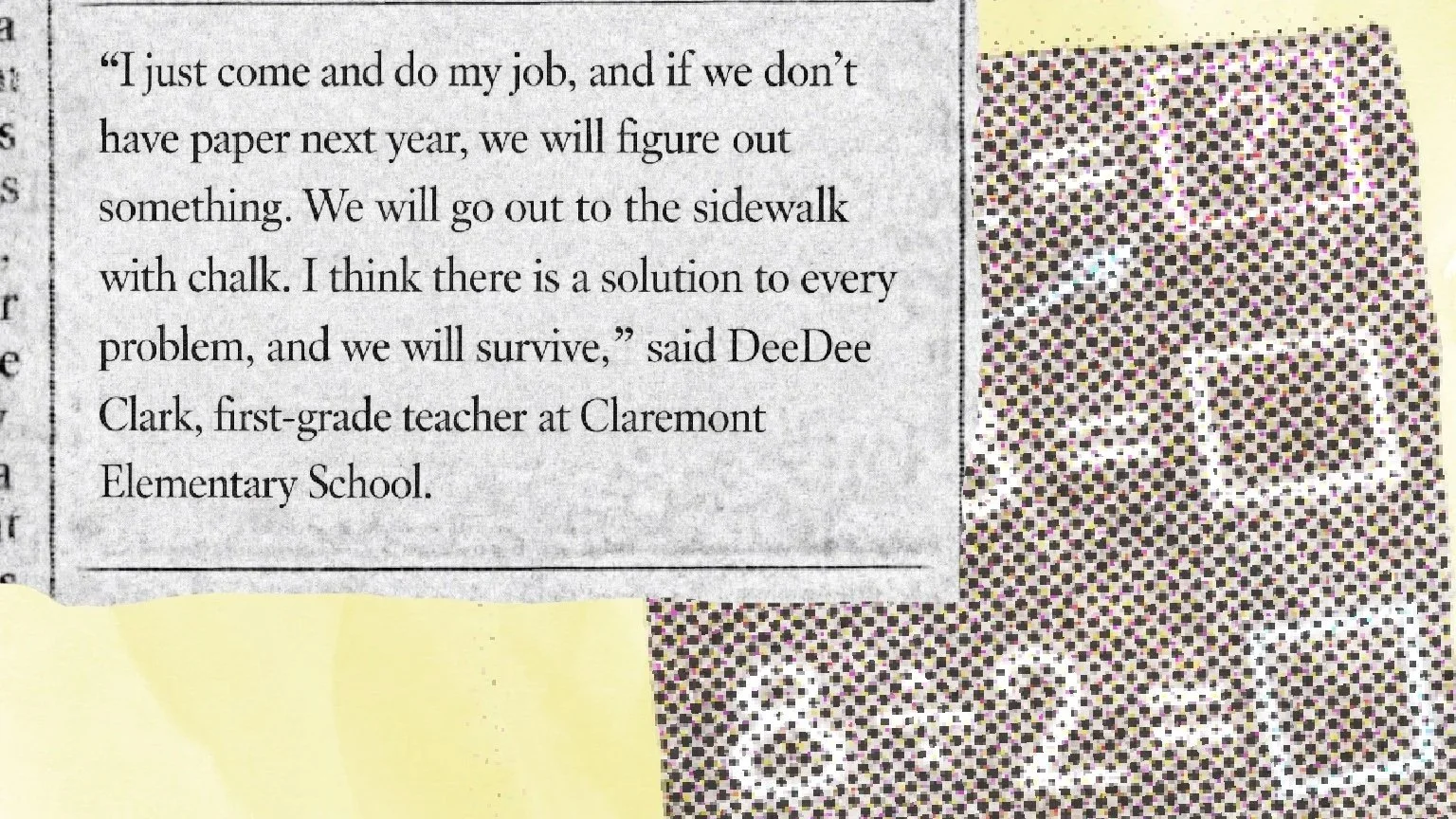
“I just come and do my job, and if we don’t have paper next year, we will figure out something. We will go out to the sidewalk with chalk. I think there is a solution to every problem, and we will survive,” said DeeDee Clark, first-grade teacher at Claremont Elementary School.
Principal Randa Fay said in the midst of surviving the current statewide budget crisis, education is made more difficult. She said $2,000 is completely inadequate to purchase supplies for a year.
“The cuts are real. We only have $2,000. It is affecting us to the point where cuts will only bring higher numbers into the classrooms and spread us thin on important tools like textbooks,” said Fay. “We are facing some serious budget problems. Superintendent (Michael) McClaren manages our schools very successfully, and he protects us, but he can only do so much.”
RCB Bank is Claremont Elementary School’s partner in education. “RCB really holds us up, and they provide for us,” said Fay.
Fay said her teachers have heart and guts and that’s what makes them successful while the schools manage shrinking budgets.
“They have absolutely no entitlement, and they just get the job done. They are resilient,” she said. “Clark is one of the most resilient teachers I know.”
Clark said she often purchases necessary supplies for projects, but she feels lucky to have the resources.
“Some first-year teachers are doing all they can just to pay their bills, car payments and paying their student loans — they do not have the ability to spend $100 for their kids to make Christmas crafts for their parents,” she said.
Clark said her most of her students get their supplies from First United Methodist Church and the Jason O’Malley Program through the Cherokee Nation.
“Thank God for the First Methodist Church and all the other churches and programs that donate. Until then, students would come to class with one glue stick thinking it would last all year, and a pencil that would eventually break,” Clark said. “I feel so humbled by how many people have stepped up to the plate.”
She said she uses outdated materials in her classroom.
“I don’t know if I am just broken-hearted we can’t get new series every five years, but reading is reading, and math is math — but if I were a history teacher with 10-year-old history books, I would be livid,” she said.
Clark said society must experience a shift in values for any meaningful change to occur.
“I am not one to go on a picket line for my rights. I have never seen any real changes affected by that, but I am not saying we shouldn’t. It just seems to me it makes people angry instead of getting them motivated,” she said.
Despite the dire budget situation, she said the greatest challenge teachers face is apathy.
“I tell parents I can’t make your child want to succeed. The problem is not paper shortage, it not emptying my own trashcan. I am not above that. I don’t even mind vacuuming my own room. For me it is a switch in the mindset from apathy to truly valuing education,” she said.
Clark has taught elementary children for 37 years, and she has experienced the impact of economic fluctuations on the classroom.
“I don’t have any words of wisdom. My job to educate the kids stays the same. I have seen highs and lows for 37 years. I experienced the oil boom and the oil bust,” said Clark. “The conversation verbiage has changed a lot throughout the years, and I wish I would have kept a journal.”
Clark started her career as a teacher in 1978, and she said despite some of the challenges education faces currently, there have been significant strides in providing higher quality and more access to public education.
“I started in a two-story small school house. We were thrilled to death to get ceiling fans. It was so hot. It was like we were on fire,” she said. “We had a chalkboard, and that was it. We would write our attendance down on a piece of paper and walk it over to the office. Everything was terribly simple.”
Now, Clark submits her attendance on her computer and she teaches lessons on a smart board. She said technology greatly changed the classroom and is helping teachers with outdated textbooks provide current curriculum.
Technology has impacted student’s level of interest in activities.
“A lot of students do not know how to play outside. They are used to being entertained by televisions and video games and they haven’t learned how to play games outside like jump rope or even ride a bike,” she said.
Clark said some students come to class with the expectation of being entertained.
“People are surprised when I tell them we have greater expectations of what kids should know now than we did when I first started teaching,” she said.
Clark said she remembers a time when kindergarten was optional, and it was not uncommon for her students to arrive on the first day of first grade without knowing their ABC’s.
“We expect more out of the kids. If they are not already reading by first grade, they will be falling behind quickly. It is crazy what we expect for them to already know now,” she said.
Ultimately, Clark said she is determined to continue to do her job well, despite how many or how few adequate tools are supplied.
Editor’s note: This is the first in a series of stories on the challenges local teachers face in the classroom during the current budget crisis.